


NPS AImEx brings together artificial intelligence and forensic expertise to identify new psychoactive substances from GC-EI-MS data. Developed by the German Federal Criminal Police Office, Quantistry and ChemInnovation, the project combines database matching with AI-supported structural suggestions. A prototype based on NXT Spectra technology demonstrated its potential in four forensic challenges, highlighting both its capabilities and limitations. Close collaboration with laboratories will guide further development, with transparency and expert judgement at the core.

The research project "NPS AImEx - Identifying New Psychoactive Substances: Artificial Intelligence meets Expertise” was presented at the international ENFSI (European Network of Forensic Science Institutes) Drugs Working Group Annual Meeting as well as within the ADEBAR network. NPS AImEx is a collaborative research project developing AI-supported approaches for the automated identification and structural elucidation of New Psychoactive Substances (NPS) from GC-EI-MS data. The German Federal Criminal Police Office (Bundeskriminalamt), Quantistry GmbH and ChemInnovation GmbH are jointly developing new approaches for the automated structural elucidation of NPS and for identifying them more quickly and reliably. To achieve this, NPS AImEx combines the evaluation of GC-EI-MS data with database matching, simulations and AI-supported structure predictions.
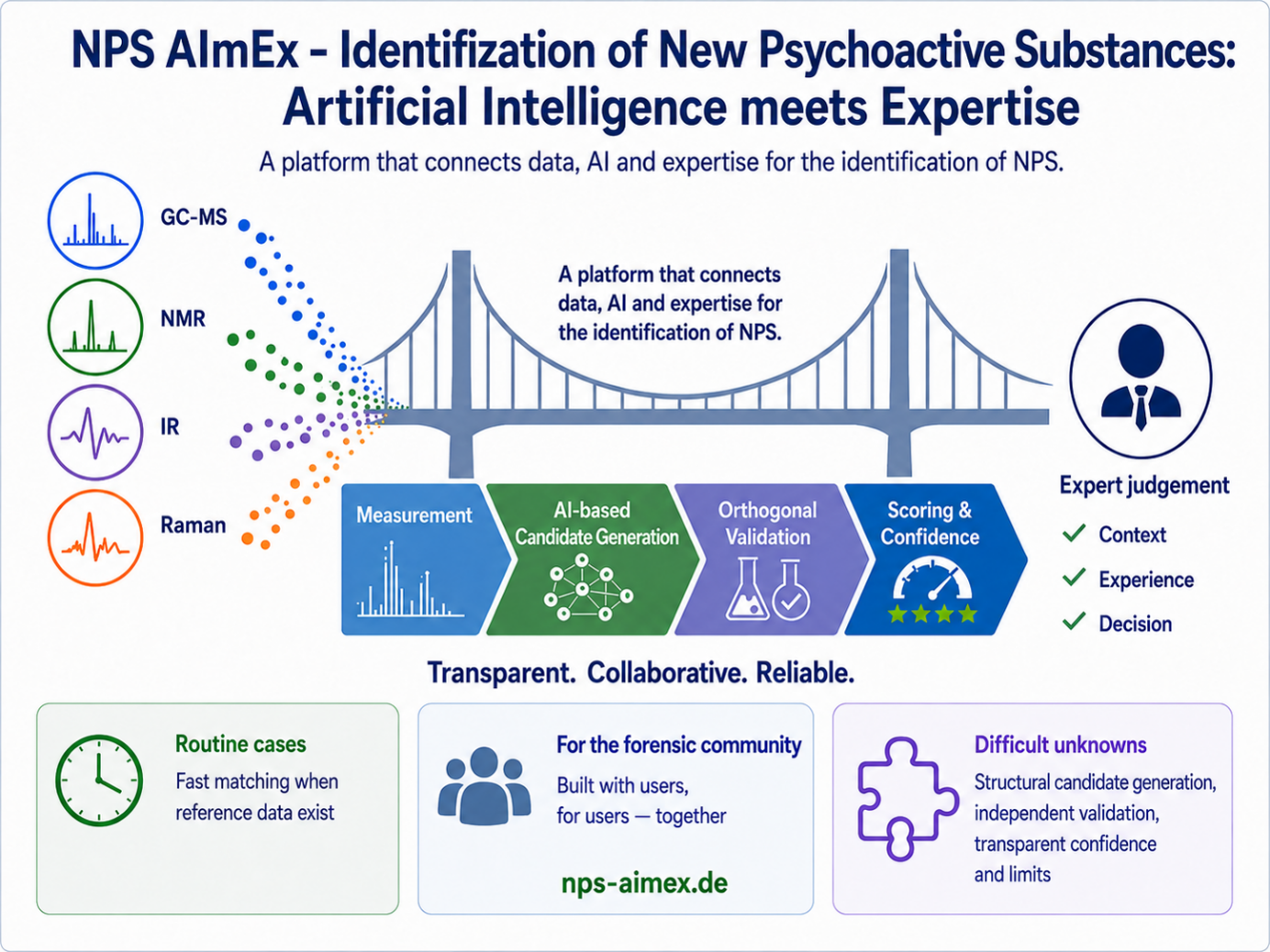
The presentation introduced the core idea and objectives of NPS AImEx, the current project overview, and the planned NPS AImEx platform. In the future, this platform is intended to support forensic and analytical laboratories in the evaluation of complex analytical data. The expert audience showed particular interest in the prototype developed jointly with ChemInnovation. This prototype builds on technologies from the NXT Spectra software, ChemInnovation’s software for AI-supported GC-EI-MS data analysis and structure identification, and serves as a practical intermediate step on the way to the full NPS AImEx platform. The prototype processes GC-EI-MS (GC-MS using electron ionization) data automatically, performs database matching, and complements the results with AI-supported structural suggestions.
A key focus of the presentation was the open exchange with potential users: participants were explicitly invited to help shape the further development of the platformAs stated: “It is not our goal to build in a vacuum." It is therefore particularly important that feedback on data formats, typical sample numbers, analytical workflows, and specific challenges from laboratory practice is incorporated into further development at an early stage. The platform is intended to be developed as closely as possible to the practical requirements of its future users.
Using four samples from real application scenarios, referred to as "challenges," the presentation demonstrated how the prototype automatically generates structural suggestions based on GC-EI-MS data, evaluates database hits and AI-supported structure predictions, and at the same time makes the limitations of the method transparent.
In the first challenge, a cannabis flower sample containing a previously unknown substance was analyzed. The prototype delivered plausible AI-based structural suggestions, but also showed that clear structural elucidation was not possible solely on the basis of the available GC-EI-MS data. This example illustrated that the platform must not only generate results, but also present uncertainties in a comprehensible way.
In the second challenge, a white powder containing a known substance was analyzed. By combining database matching and artificial intelligence, the prototype correctly identified the substance as cocaine. This example demonstrates the benefit of the system particularly when suitable reference data are available and a reliable assignment can be supported by established comparative methods.
The third challenge proved particularly impressive: it involved a white powder containing an unknown substance from an ENFSI DWG proficiency test in 2024. In this proficiency test, 14 of the 29 participating institutes were unable to correctly determine the structure and isomerism. The prototype, by contrast, delivered the correct structural suggestion and additionally indicated those isomers that cannot be distinguished with certainty using GC-EI-MS alone. In such a case, the final structural elucidation can be achieved through simulation and comparison with a second, orthogonal — that is, methodologically independent — analytical method. This approach clearly demonstrates the innovation potential of NPS AImEx: The approach has the potential to make specialized analytical capabilities more broadly accessible while supporting trained experts in transparent and methodologically sound structure elucidation.
The fourth challenge made the limitations of the approach particularly clear. Due to the low information content of the spectrum, no plausible structural suggestions could be generated for the brownish powder containing an unknown substance. Even with the help of database matching and AI-based analytical methods, no robust structural hypothesis could be derived. Nevertheless, it was possible to obtain indications of the substance class from the few available fragment signals. This example shows that physical and analytical limitations remain in individual samples. This makes it all the more important that a responsible prototype communicates such limitations transparently and that the final assessment continues to be carried out by trained specialists.
In the further course of the project, additional datasets will be evaluated and video discussions will be held with selected interested parties. The goal of these discussions is to identify requirements from practical application at an early stage and to align the further development of the NPS AImEx platform consistently with the needs of its future users.
